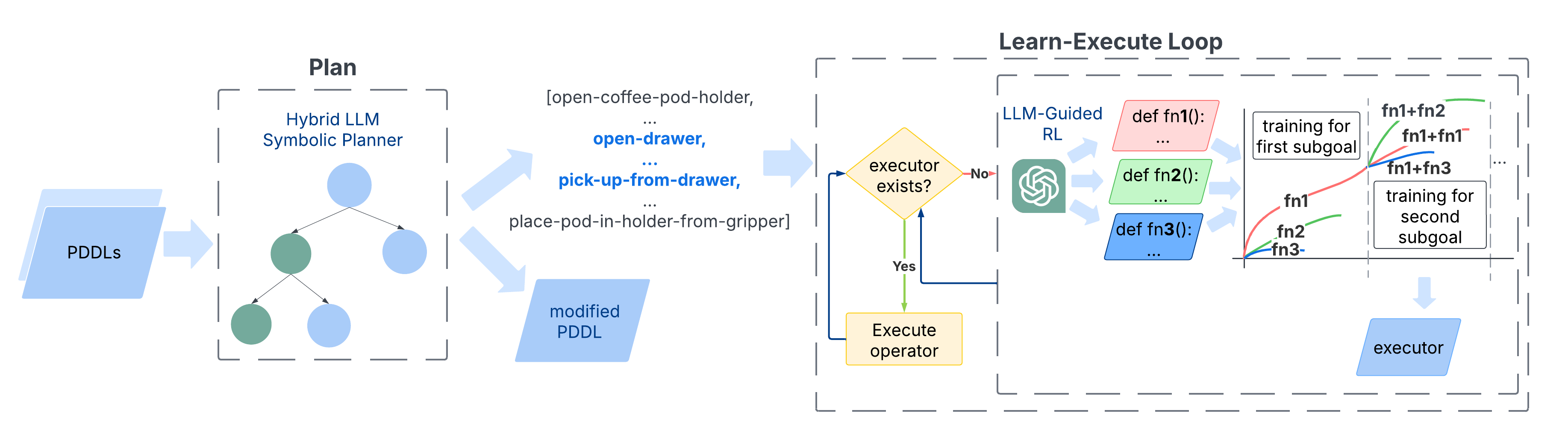
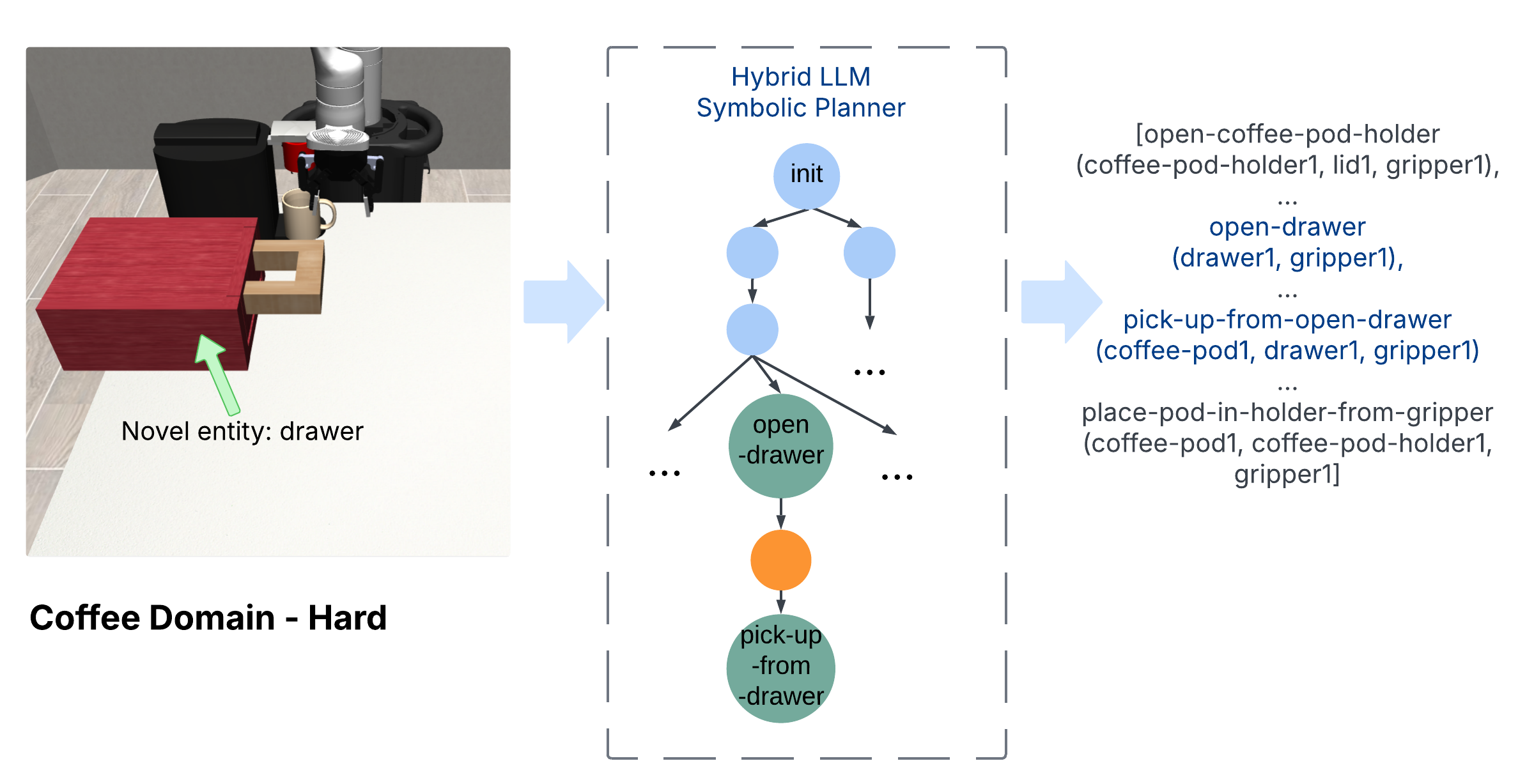
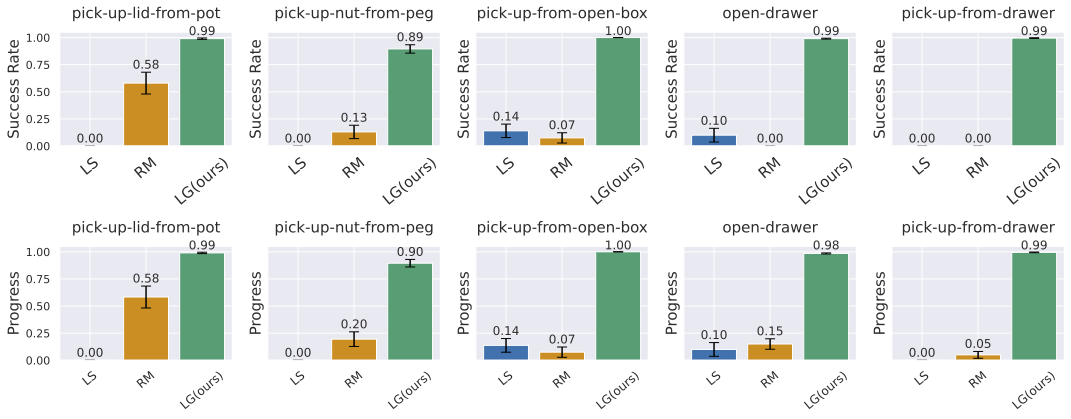
In dynamic open-world environments, autonomous agents often encounter novelties that hinder their ability to find plans to achieve their goals. Specifically, traditional symbolic planners fail to generate plans when the robot's planning domain lacks the operators that enable it to interact appropriately with novel objects in the environment. We propose a neuro-symbolic architecture that integrates symbolic planning, reinforcement learning, and a large language model (LLM) to learn how to handle novel objects. In particular, we leverage the common sense reasoning capability of the LLM to identify missing operators, generate plans with the symbolic AI planner, and write reward functions to guide the reinforcement learning agent in learning control policies for newly identified operators. Our method outperforms the state-of-the-art methods in operator discovery as well as operator learning in continuous robotic domains.
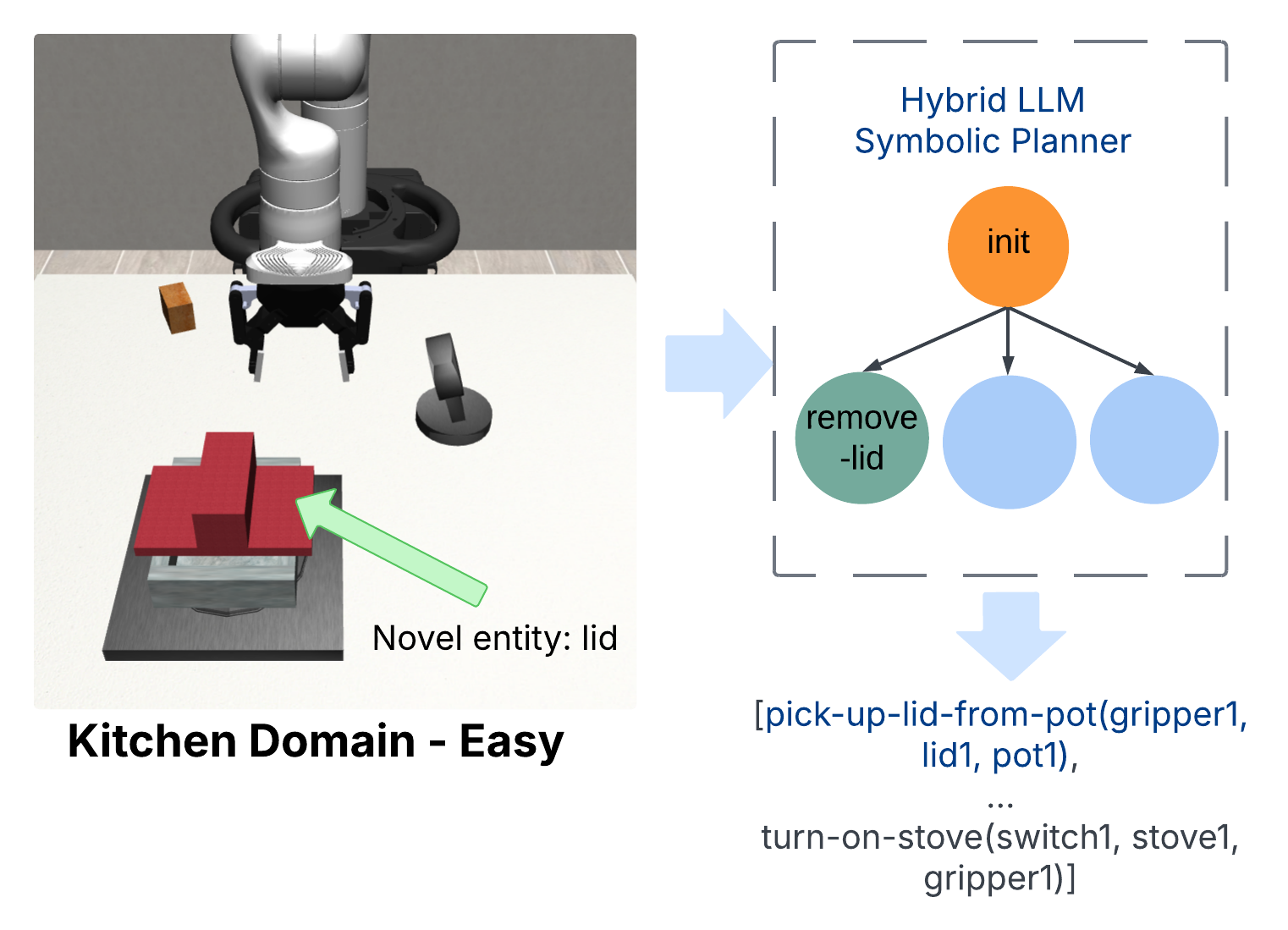
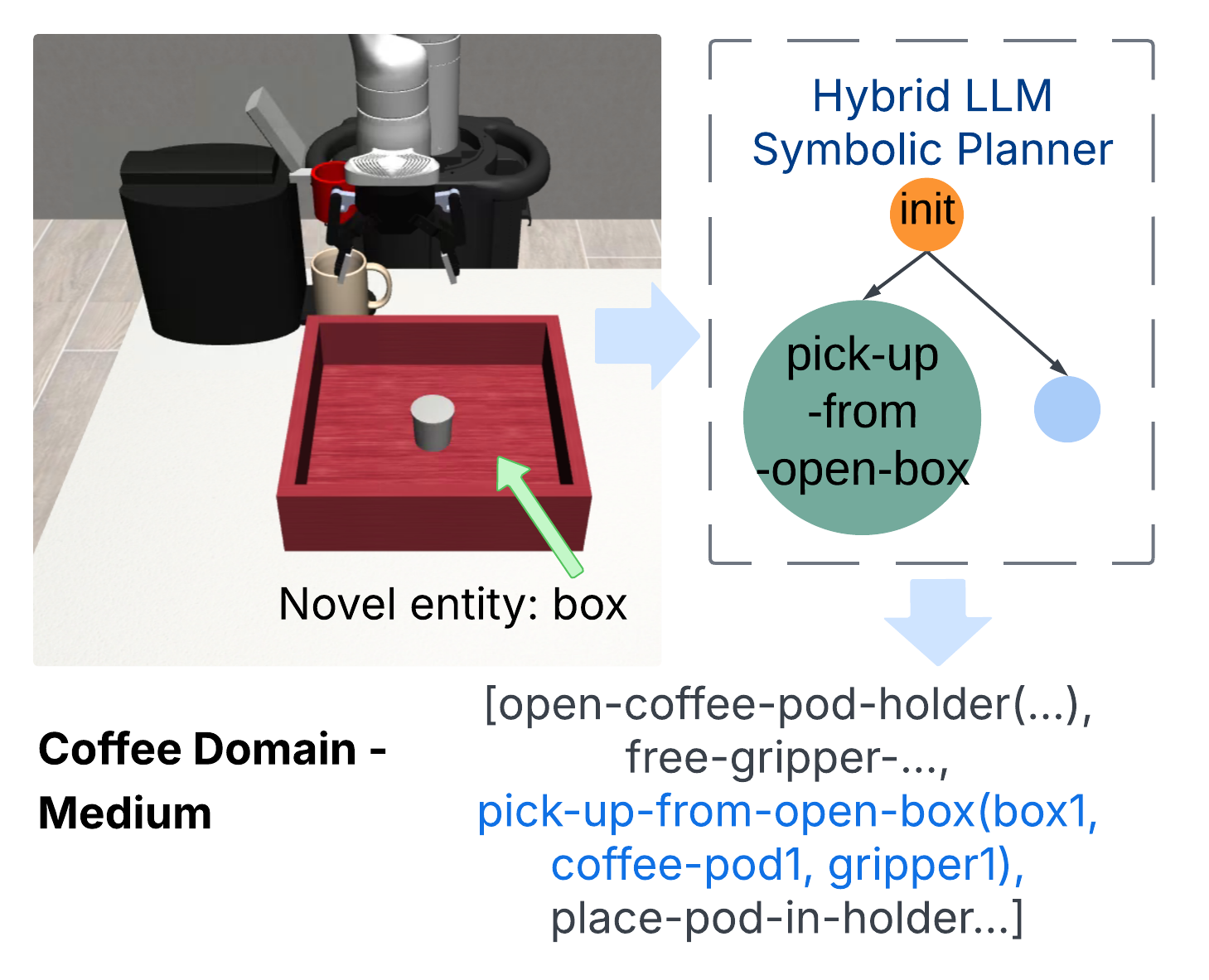
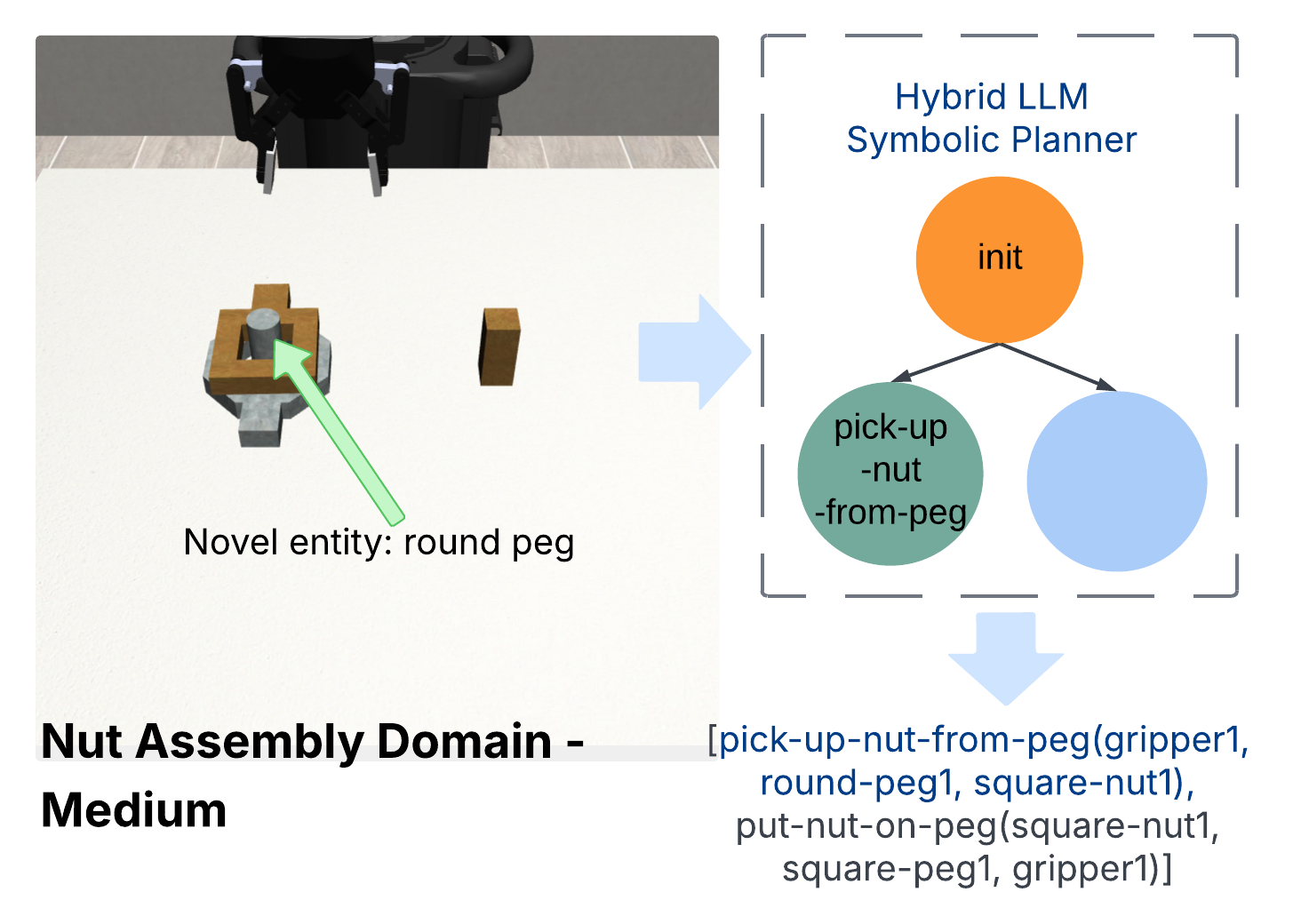
| Domain | Hybrid Successes | OD Successes | Hybrid Time | OD Time |
|---|---|---|---|---|
| Kitchen | 10/10 | 10/10 | 75.19 sec | 85.51 sec |
| Nut Assembly | 10/10 | 0/10 | 120.76 sec | >7h |
| Coffee (box) | 10/10 | 0/10 | 45.26 sec | >7h |
| Coffee (drawer) | 7/10 | 0/10 | 681.83 sec | >7h |
Identifying missing operators. Across ten runs per domain, the hybrid planner succeeds in every Kitchen, Nut Assembly, and Coffee-Box run and seven Coffee-Drawer runs. Operator Discovery (OD) succeeds only in Kitchen. OD searches through reinforcement learning, with each run capped at one million timesteps; the hybrid planner instead uses LLM suggestions and symbolic search to identify the missing operators.

@misc{lu2026noveltyadaptationhybridlarge,
      title={Novelty Adaptation Through Hybrid Large Language Model (LLM)-Symbolic Planning and LLM-guided Reinforcement Learning},
      author={Hong Lu and Pierrick Lorang and Timothy R. Duggan and Jivko Sinapov and Matthias Scheutz},
      year={2026},
      eprint={2603.11351},
      archivePrefix={arXiv},
      primaryClass={cs.RO},
      url={https://arxiv.org/abs/2603.11351},
}